 Skip to content

“Portable” is not a sterilization technology. It is a use case. A product becomes genuinely travel-friendly only when its size, power source, capacity, cleaning method, operating sequence and safety controls work outside the predictable environment of a home countertop. That distinction matters because many small appliances are marketed as portable simply because they are compact, even though they still depend on a wall outlet, a specific container, a large water supply or a careful setup that is inconvenient in transit.
For OEM buyers, the correct sequence is to define the travel scenario first and then select the architecture. A compact electric steam unit, a microwave steam container, an enclosed UV-C device and a battery-powered UV-C cap or chamber can all be “portable,” but they solve different problems. They also create very different claim, charging and support requirements.
This guide is for distributors and private-label brands evaluating travel sterilizers. It focuses on what needs to be verified before the product is positioned for airports, hotels, road trips, grandparents’ homes, daycare bags or other away-from-home use.

Define the Travel Job Before You Choose the Product
Travel is not one scenario. A parent staying in a hotel may have access to mains power, a sink and counter space. A family in a car may have USB power but limited clean water. An airline passenger may need a compact storage or sanitizing solution but face restrictions on liquids, batteries and what can realistically be operated during a flight. A grandparent’s home may have a microwave but no dedicated baby appliance.
The product brief should therefore state where the product is expected to be used and what infrastructure can be assumed. Useful questions include:
- Is mains power normally available?
- Is a microwave normally available?
- Is USB-C or another low-voltage source part of the concept?
- Does the product contain a rechargeable lithium battery?
- How much clean water is required per cycle?
- How many bottles or accessories need to be processed at one time?
- Must the product operate fully away from a sink?
- How will wet or cleaned items be handled before and after the cycle?
- What is the maximum packed size and weight for the intended bag or channel?
- What cleaning tools can realistically travel with the product?
A supplier cannot optimize portability until the buyer defines these constraints.
Compare Portable Architectures by Their Dependencies
The most important difference between portable products is what they depend on to work.
| Portable architecture | Main dependency | Main advantage | Main sourcing concern |
| Compact mains steam | wall power + water | familiar steam workflow in smaller housing | still not cordless; leakage, hot water, scale and plug compatibility |
| Microwave steam container | compatible microwave + water | simple construction and no internal electronics | microwave dimensions/power, handling hot container, local availability |
| Battery UV-C chamber/cap | charged battery + suitable load geometry | cordless, heat-free treatment | optical coverage, interlocks, battery life, claim evidence |
| USB-powered UV-C device | compatible external power source | lighter than a battery design | cable/adapter compatibility, power stability, no true cordless use |
| Small storage/drying device | cleaned items + airflow | supports organization/drying rather than thermal treatment | avoid presenting storage/drying as sterilization unless separately supported |
This matrix prevents the buyer from comparing only headline dimensions. A product may be physically small but operationally dependent on an environment the target customer rarely has.
For the technology-level tradeoffs, review Steam vs UV baby bottle sterilizers. For the full OEM sourcing sequence, use the Baby Bottle Sterilizer Guide for OEM Buyers.
Portability Should Be Measured as a Complete Travel Kit
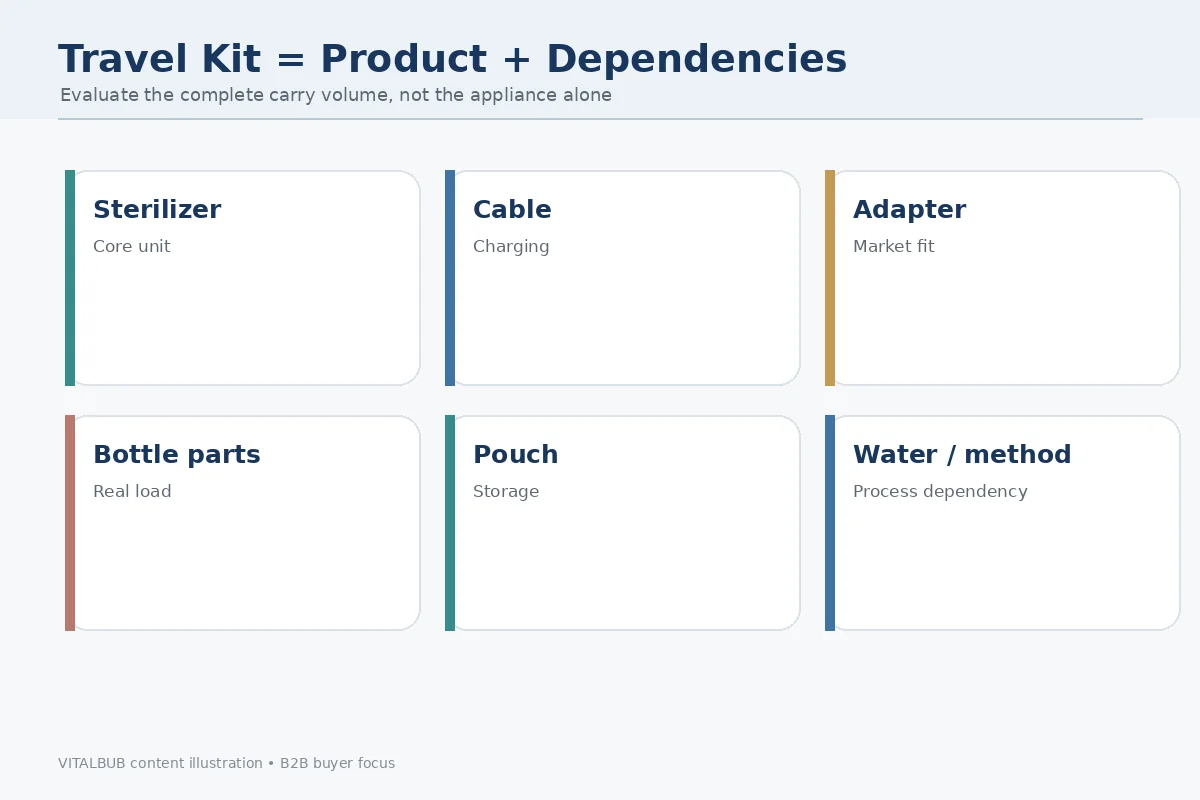
Do not evaluate only the appliance body. The real kit can include an adapter, cable, water measure, tray, protective cap, pouch and spare accessories. A compact housing with a bulky adapter and loose pieces may be less travel-friendly than a slightly larger integrated design.
Record:
- product dimensions and weight;
- packed dimensions and weight;
- charging adapter/cable dimensions;
- number of loose accessories;
- whether parts nest inside the appliance;
- whether water must be emptied before packing;
- whether the product can accidentally switch on in a bag;
- whether fragile transparent parts need a protective case;
- whether the lid stays closed under normal transport movement.
Then test the kit in the actual type of bag or shelf environment targeted by the channel. The goal is not a universal “smallest” product; it is a product that packs and unpacks predictably.
Battery Runtime Needs a Realistic Operating Profile
For rechargeable portable sterilizers, battery capacity on the cell specification is not enough. The buyer needs to know how many defined cycles the complete product can perform when new, how runtime changes as the battery discharges and how the unit behaves near low state of charge.
A useful battery test includes:
- Charge the production-intent sample with the intended adapter/cable.
- Record charging time and any abnormal heat.
- Run the defined program under the representative load.
- Repeat until the product reaches its normal low-battery cutoff.
- Record successful cycles, cycle duration and any degradation in output or behavior.
- Recharge and repeat to check consistency.
- Test the product after a realistic period of non-use to observe self-discharge and wake behavior.
If the UV output or fan behavior can vary with battery voltage, confirm that the control system does not silently deliver a weaker result while still displaying a normal cycle completion. The design should define what happens when there is insufficient energy to complete the intended process.
USB-C Does Not Automatically Mean Universal Travel Compatibility
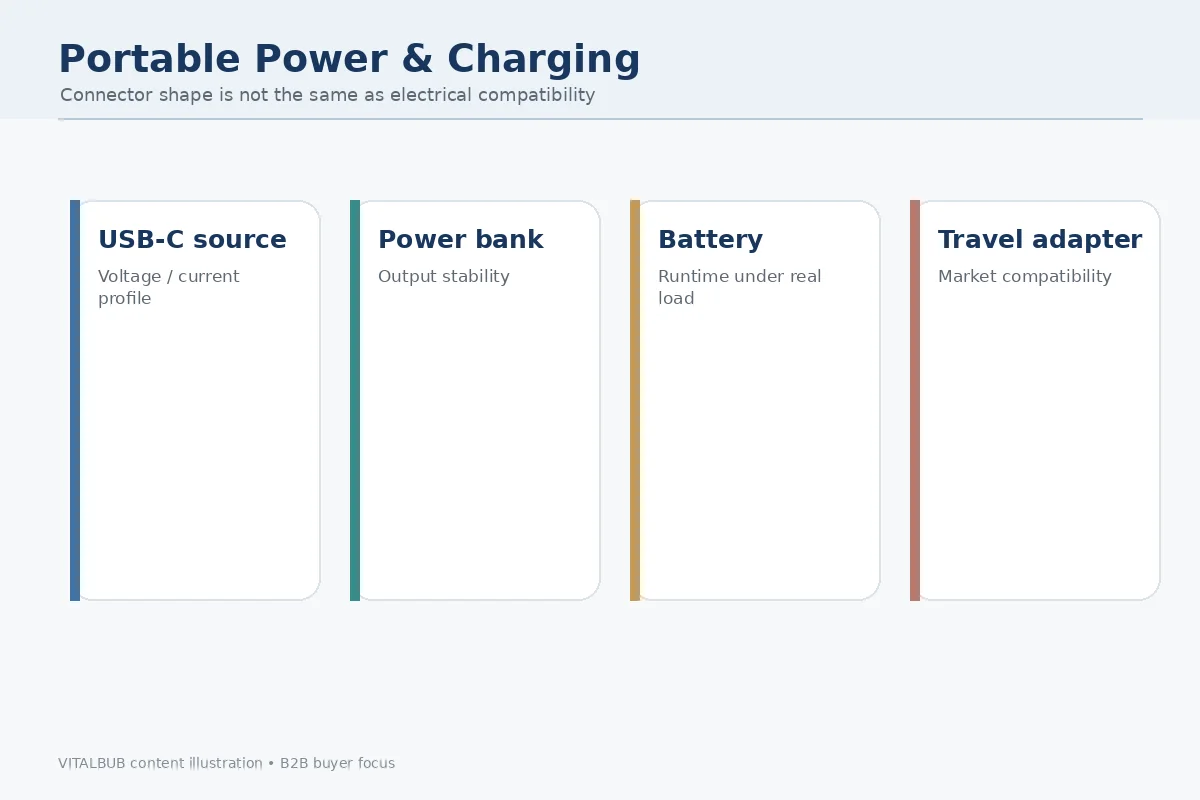
USB-C is useful because customers may already carry compatible power sources, but the connector shape alone does not define the electrical behavior. The product specification should identify required input voltage/current or power profile, whether a particular charging protocol is needed, whether the unit can operate while charging and which adapter/cable is included.
Test common realistic conditions rather than only the factory bench supply. If the brand intends to say the product can be powered from a power bank, validate representative power banks and document the minimum required output. Some power banks can shut down when the load is too low or behave differently with intermittent loads.
If the product contains a lithium battery, transportation requirements and shipping documentation may also apply. Airline carriage rules can differ from product shipping rules and can change over time, so a packaging claim such as “airline approved” should not be printed casually. Provide battery specifications and let customers follow current carrier/aviation rules rather than using an unsupported universal travel endorsement.
UV-C Portable Products Need Optical Safety Before Marketing Creativity
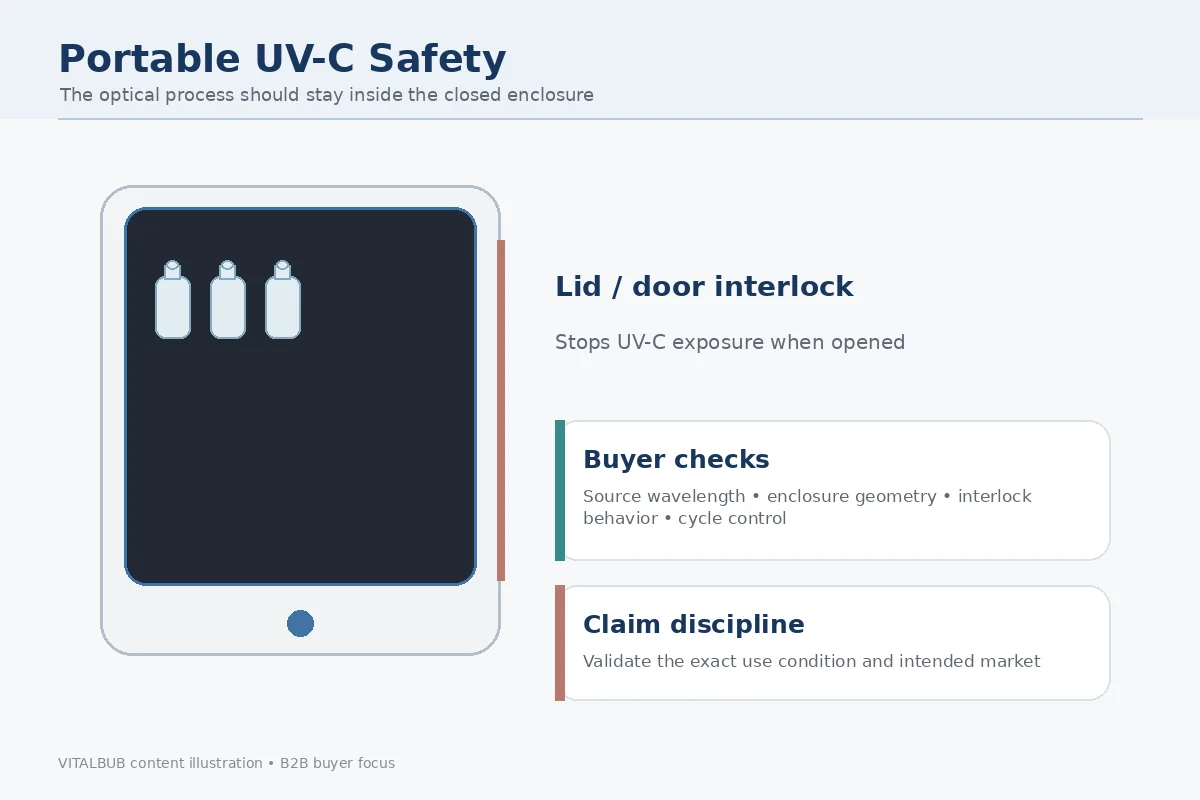
Portable UV-C products are attractive because they can be cordless and do not need a steam-water cycle. They also require disciplined design because UV performance depends on exposure, distance, geometry, reflection and shadowing.
The buyer should understand:
- UV source type and wavelength range as specified by the component supplier;
- location and number of sources;
- how the design handles shadowed surfaces;
- whether the chamber must be closed for operation;
- interlock behavior if the lid opens;
- whether operation can start with the enclosure incorrectly seated;
- source life and replacement/service strategy;
- material compatibility with repeated UV exposure;
- what evidence supports the exact microorganism-control claim.
A product should fail safe if exposure could reach the user. Do not treat a lid switch as a decorative feature; test it repeatedly and after normal mechanical wear. If the product uses a transparent or translucent enclosure, confirm the intended optical containment rather than assuming appearance equals protection.
In the United States, EPA notes that devices using physical means such as UV light to control microorganisms can fall within pesticide-device regulation. The EPA pesticide device guide also warns that an EPA establishment number is not the same as EPA approval of a device’s efficacy. This is why claim wording should be reviewed before marketplace content is produced.
Do Not Use “99.9%,” “Medical Grade,” or IP Ratings as Decoration
Travel products are often marketed aggressively because the concept is easy to visualize. That is exactly why buyers should remove unsupported badges before launch.
A microbial-reduction percentage needs evidence for the exact device, process and claim conditions. “Medical grade” needs a defined, defensible meaning and may create an unintended regulated-use implication depending on context. An IP rating such as IP54 is a specific ingress-protection classification; it should not be chosen because it sounds durable. If the product has not been designed and tested to a documented IP rating, do not print one.
A safer commercial approach is to state the measurable facts that matter: enclosure type, charging method, product dimensions, tested runtime, supported bottle/accessory sizes, interlock behavior and the validated claim wording.
Compact Steam Products Trade Cordless Convenience for Familiar Process
A compact steam unit can be a strong travel product when the user has mains power and clean water. The technology is familiar, and the product can avoid battery life and UV coverage questions. But miniaturizing a steam product can create its own challenges.
Small water volumes make filling accuracy more sensitive. Compact housings can make hot surfaces, vent direction and safe removal more important. A narrow chamber may fit fewer bottle types than the product photographs suggest. The buyer should test the intended use case with the exact plug, local voltage and representative bottles.
Review:
- water measure and fill markings;
- stability on small counters;
- cord length and storage;
- vent direction in tight spaces;
- lid-opening path after a hot cycle;
- safe draining and cool-down;
- scale cleaning with limited basin access;
- whether the product can be fully emptied before packing.
A portable steam product that retains water in inaccessible spaces can create odor, leakage or hygiene complaints when repeatedly packed in a bag.
Capacity Claims Need More Discipline in Portable Products

Portability and capacity pull the design in opposite directions. A very compact chamber may only hold one or two items, while a larger chamber weakens the travel proposition. There is no correct universal capacity; the product needs a clear job.
For a single-bottle or pacifier product, say so. For a multi-item chamber, show the tested arrangement. Do not combine separate maximums in one image—for example, showing “fits two bottles + pump parts + toys” if the chamber cannot hold them simultaneously.
Use representative dimensions rather than brand names when possible. Brand-specific compatibility can change as bottle designs change. An approved dimensional envelope is easier to control in a specification and safer for long-term support.
Travel Cleaning Is Often Harder Than Home Cleaning
Away from home, users may have limited drying space, uncertain sink cleanliness and fewer brushes or drying racks. A travel sterilizer should not make the cleaning sequence more complicated than necessary.
The CDC’s infant feeding item guidance emphasizes cleaning before sanitizing and thorough drying/storage practices. That matters for portable products because a device marketed for “on-the-go hygiene” can easily be misinterpreted as a replacement for cleaning.
Ask how the user will:
- pre-clean feeding items;
- drain the appliance;
- dry the appliance itself;
- keep cleaned and processed items separate from dirty ones;
- store the device after use;
- clean a UV chamber or steam basin without immersing electronics;
- handle the product when a full wash area is unavailable.
A removable washable tray or smooth internal surfaces may create more real travel value than another electronic mode.
Portable and Countertop Sterilizers Should Have Different Portfolio Jobs
A portable product does not need to replace the home unit. In many assortments, the clearest positioning is complementary: the countertop sterilizer handles normal daily volume, while the portable SKU handles trips, backup use or small loads.
This reduces pressure to force home-scale capacity into a travel housing. It also creates a more coherent retail comparison. The portable product can be smaller and simpler because the buyer is not promising it as the only sterilizer for every household.
For a distributor, compare the two products by job:
| Decision factor | Portable SKU | Countertop SKU |
| Main job | travel, backup, small loads | regular home routine |
| Capacity | intentionally limited | larger daily load |
| Power | battery/USB/microwave/compact mains depending on architecture | normally mains powered |
| Packaging | optimized for small format and transport | optimized for retail presentation and home storage |
| Support | charging/travel/fit questions | scale/capacity/drying questions |
| Value story | mobility and convenience | throughput and routine automation |
Compliance Planning Follows the Architecture
A portable product can introduce additional compliance topics depending on its design. A mains steam unit has electrical and thermal considerations. A battery product adds battery and charging requirements. A connected product can add radio/software considerations. A UV-C device adds claim and exposure questions.
For EU consumer products, the broader General Product Safety Regulation is one part of the safety and traceability framework. Product-specific electrical, EMC, radio, battery, chemical, food-contact and other requirements may also apply depending on the final configuration.
Do not let a supplier’s certificate folder drive the product classification. First freeze what the product is and what it claims; then build the compliance matrix for the destination market with a qualified laboratory or adviser.
Packaging Should Survive the Travel Story It Sells
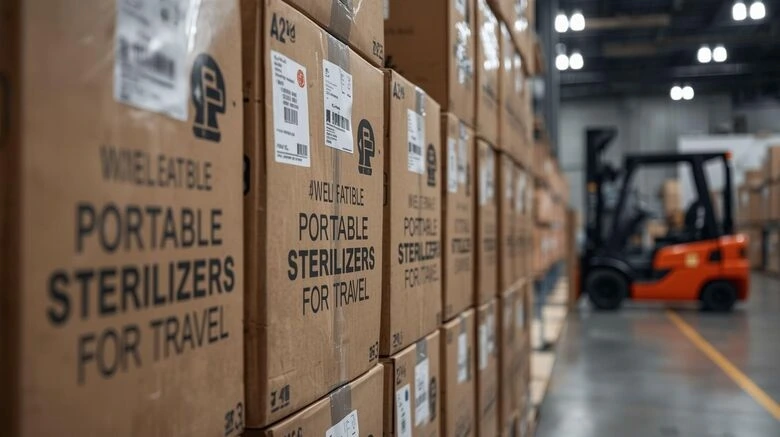
A portable sterilizer is likely to be handled more than a home appliance. Hinges, transparent lids, charging ports and small accessories can be exposed to repeated packing. The retail package should protect the product during normal distribution, and any travel pouch or protective accessory should be tested as part of the kit.
The OEM baby appliance packaging guide provides the broader transport-validation process. For portable products, add checks for:
- loose accessory retention;
- charging-port protection;
- accidental button activation;
- lid latch durability;
- pouch abrasion;
- packed cable stress;
- residual water instructions;
- battery shipping labels/documents where applicable.
Do not validate the package with a nonfunctional appearance sample if the production battery, adapter or accessories change the weight and center of gravity.
Portable Sterilizer Sample Test Plan
Use the baby appliance sample testing checklist as the base and add travel-specific scenarios.
Scenario 1: Hotel room
Set up the product on a small counter with the actual travel adapter/plug configuration. Run the full process, empty and repack it. Record what extra items the user needed.
Scenario 2: USB/power bank use
For products designed for this, run with representative compliant power sources. Record startup, full-cycle completion and behavior when the power source is marginal or disconnects.
Scenario 3: Battery depletion
Run repeated cycles from full charge to normal cutoff. Confirm the product does not report success when it cannot complete the intended process.
Scenario 4: Bag transport
Pack the dry product with all accessories, move it through realistic handling, then inspect latch, buttons, ports and accessory retention.
Scenario 5: Cleaning and drying the device
After several normal cycles, clean it using only the manual and realistically available travel tools. Check trapped water, scale or inaccessible areas.
Scenario 6: Claim-specific test review
Confirm that UV-C or microbial claims match the exact production-intent configuration and load conditions. Buyer-side checks do not replace formal claim substantiation.
Supplier Questions for a Portable Project
Ask:
- What travel scenario was the product originally designed for?
- What external equipment does it require?
- Which power inputs are supported and tested?
- If battery-powered, what cell type/capacity and protection architecture are used?
- How many defined cycles does the sample complete from full charge?
- What happens at low battery?
- If UV-C, how are exposure, shadowing and interlocks controlled?
- Which claim reports belong to this exact model and source configuration?
- How is the appliance emptied and dried before packing?
- What bottle/accessory dimensions were tested?
- Which parts are likely to need replacement after launch?
- What changes trigger retesting or claim review?
The answers should become part of the controlled specification, not remain only in chat history.
Frequently Asked Questions
Is a portable UV sterilizer better than a portable steam sterilizer?
They solve different constraints. UV-C can avoid carrying water and can support cordless designs, but it requires careful optical geometry, exposure control and claim evidence. Compact steam is familiar and heat-based but needs water, power and hot-cycle handling. Choose from the travel scenario rather than the technology label.
How many cycles should a rechargeable travel sterilizer provide?
There is no universal number that fits every product. Define the intended travel scenario, battery size, program and acceptable product weight, then measure the production-intent sample. Publish only a runtime/cycle claim that can be reproduced under stated conditions.
Does USB-C mean I can use any phone charger?
No. USB-C is the connector/interface family, but the product may require specific voltage, current or power profiles. State the input requirement and included accessories clearly, and validate representative power sources.
Should a portable sterilizer have an IP rating?
Only if the design and test evidence support a specific ingress-protection rating and the rating is relevant to the intended use. Do not add IP54 or another code as a general durability badge.
Can we market a UV travel device as “medical grade”?
Avoid the phrase unless the company has a clear, defensible basis and has reviewed the regulatory implications for the intended product and market. Precise measurable specifications are generally safer and more useful.
Is a travel pouch enough to make the product portable?
No. Evaluate the complete operating dependency: power, water, capacity, cleaning, drying, battery, accessories and packing behavior. A pouch improves carrying but does not solve an impractical workflow.
Should the portable SKU replace the main countertop SKU?
Usually it is clearer to give the products different jobs. The portable SKU can serve travel and small-load use while the countertop product handles daily family volume. This reduces pressure to compromise both designs.
Final OEM Buyer Checklist
Before approving a portable sterilizer, confirm:
- the exact travel scenario is defined;
- product and complete kit dimensions/weight are acceptable;
- required external power/water/microwave dependencies are explicit;
- battery runtime and low-charge behavior are tested where applicable;
- charging input, cable and adapter requirements are controlled;
- UV-C exposure and claims are validated for the final design where applicable;
- hot-cycle handling is practical for compact steam products;
- capacity is shown with representative real objects;
- cleaning and device drying are realistic away from home;
- unsupported IP, medical-grade or microbial claims are removed;
- packaging protects the product during both distribution and repeated travel handling;
- the golden sample includes battery/source/firmware revisions and claim evidence.
A travel sterilizer succeeds when the product is portable in practice, not only in a lifestyle photograph. Buyers who start with the real use case can choose the correct architecture, avoid unsupported claims and build a product that is easier to explain and support.
For the broader sourcing framework, return to the Baby Bottle Sterilizer Guide for OEM Buyers. To review a portable sterilizer concept, contact VITALBUB with the target countries, use scenario, power architecture, capacity and intended claims.

VP at VITALBUB | Driving Excellence in Baby Care & Smart Home Appliances | Empowering Global Partnerships


